








A review of waste management maturity in six countries
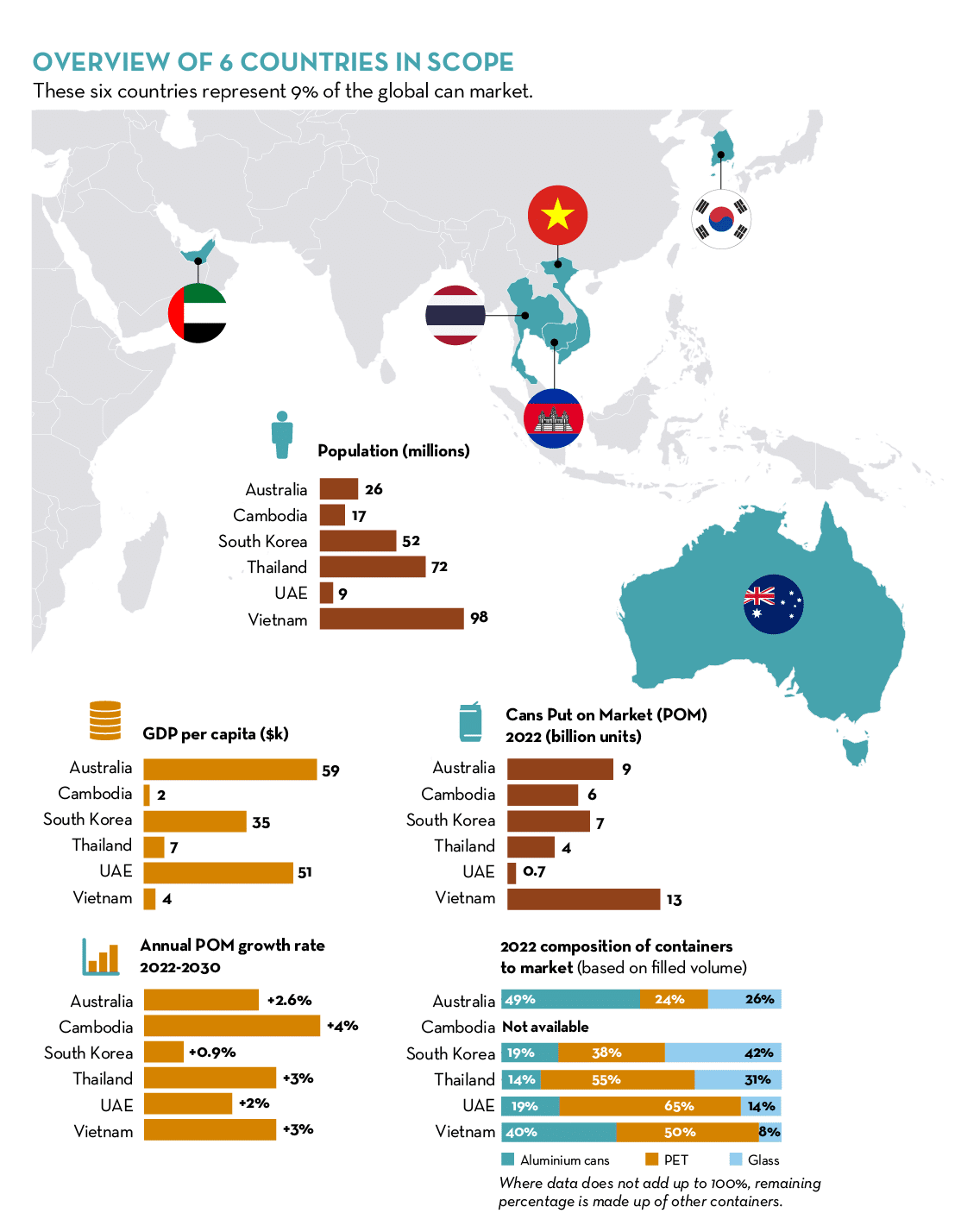
In 2023, the IAI commissioned Roland Berger to look into the current situation around aluminium can waste management and improvement levers in Australia, Cambodia, South Korea, Thailand, United Arab Emirates and Vietnam.
Together, these countries provide representative insights into can usage, collection, and processing across different countries and cultures. The assessment also provides insight into the regional trade flows of used beverage cans (UBC) scrap in the Gulf and Asia Pacific regions – both major trading hubs.
The study identified that 60 million tonnes of CO2e per annum could be saved through effective global recycling of used beverage cans by 2030.
For each of the six countries, various aspects were analysed, including:Waste management and regulatory schemes; Collection infrastructure; Recycling and landfill rates; Volumes on market; Usage trends; Overall performance; Used beverage can trade; Material flows; Future recycling targets
The six countries fall into three broad categories:
- Countries dependent on informal aluminium can collection mechanisms (e.g. Thailand, Cambodia and Vietnam). They rely on a high number of informal workers. As cans generate revenue for the sector, these countries report high recovery rates.
- Developed systems (e.g. Australia, South Korea). These rely on complex waste management systems such as extended producer responsibility (EPR) and/or deposit return systems (DRS).
- Transitioning systems (e.g. UAE). Here the collection infrastructure is largely fully developed but does not include mandatory or well-functioning EPR, nor DRS systems.
The aluminium can continues to be the package of choice for the alcohol and soft drinks industries with global consumption expected to increase by 50 per cent between 2020 and 2030 (i.e., from 420 to 630 billion cans annually).
The study was co-funded by Emirates Global Aluminium, Crown Holdings, Australian Aluminium Council and Novelis.
The review involved stakeholder interviews, regulation reviews, market and value chain assessment,
data collection and data models and baselining (volumes, rates, prices, etc.).
A detailed visualisation based on the data developed by Roland Berger is now available on alucycle.